Showing posts with label FD. Show all posts

Thursday, May 31, 2012

The war of the 24 mm - Sony vs Canons

This text will compare the following four different lenses at 24 mm aperture:


  • Canon FD 24mm 2.8
  • Canon EF 24-105mm L
  • Canon EF 17-40mm L
  • Sony 18-55mm kit lens


First the Center crop:


Note that the Canon EFs are wide open at f/4, because of heavy vignetting caused by the adapted when closing its iris control. We'll have a look at the effect of the iris in a follow-up post.

Upper Left crop


Upper Right Crop


Lower Left crop


Lower Right crop


The results shows again the lower quality of the Sony 18-55 kit lens compared against the Canons. Unsurprisingly, the FD 24mm prime is the sharper of the bunch, and maintains good performance even in the corners. Amongst the two EF zooms, the 17-40mm looks sharper and with less chromatic aberration, especially in the Upper Left and Right corners. The 24-105mm L it's a bit disappointing, considering its cost.

Wednesday, May 30, 2012

Canon FD 50 mm f1.4 vs Sony 18-55 kit lens

This test compares the Canon FD 50mm f/1.4 against the Sony 18-55 kit lens, both stopped at f/5.6, using the above reference points for center and corners. The FD lens was focused manually with the help of Sony's Nex-7 focus peaking and magnification features, the Sony lens was set in default Autofocus mode.


This test was very unfair for the humble Sony 18-55 kit lens: there's no way a cheap kit lens like this one could compete with the classic FD 50 prime. If anything, it demonstrates how inadequate the kit lens is for the very high resolution Nex-7 sensor. There's no need to spend lots of money to get an expensive "german glass": even an affordable Canon FD it's enough to improve a lot over the Sony 18-55 kit lens. It's very interesting to note how an almost 40-years design like the Canon FD 50, can still offer very good quality today.

Sony NEX 7 with Canon FD Lenses test

These classic Canon FD Lenses will be used for some test with the Sony NEX-7 mirrorless camera. The camera can be connected to a Canon FD lens, using an FD-NEX Adapter. They can be easily found in many stores, with different levels of manufacturing accuracy. I'm using a fairly high quality adapter made by italian optical factory COMA

Thursday, May 3, 2012

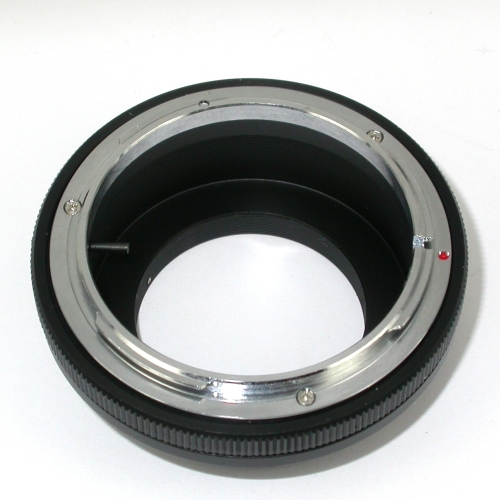
The Canon FD Adapter for the Sony Nex series (E-Mount)

There are many adapters on the market for the Sony Nex, from the low-quality chinese items sold on Ebay, to better constructed models with higher prices. Being based in Italy and as an amateur astronomer too, I chose the ones made and sold by COMA (Costruzioni Ottiche Meccaniche) by mr. Adriano Lolli, a very well known name in amateur astronomy circles, for his astrophotography accessories and rings.

http://www.adrianololli.com/raccordi.asp?tipo=F

As you can see on that link, there are many lens adapters for the Sony E-Mount used by the Nex series. We'll cover specifically the Canon ones.

The Canon FD Adapter


Ring of conversion, Link, Adapter objective Canon FD ... baionetta E mount . It allows to climb on all the objectives, telescopes, microscopes and other optic tools with photographic attack Canon FD on the serious focameres baionet E mount . The photographic objectives Canon FD climbed on on the photocameras E mount preserve the mass to fire to the endless one. Note, any tramissions of automatisms is not had. You photographs in manual. Warning: before verify the compatibility of your camera for the use of fittings. The functioning of reflex with rings adapters can vary from model to model and brand to brand. Usually a camera has only modern electrical contacts that interact with the target, noting the diaphragm, light and fire. While optical adaptations have no contact or are totally different. However they can not send information to the camera, so some machines do not work automatically or, in very exceptional cases, not taking. Generally work in manual mode, even in some must vary certain parameters settings so they can make the shot. Some instruction booklets explaining the mode of operation of the camera when using instruments such telescopes and optical microscopes or old. The verification system can be made simply by removing the lens from the camera, at this point try to make the step with the change of time for the right exposure. By changing shooting mode generally on M will observe the operation thereof. For more info write Realized in resistant full metal They are available other types of adapters for cameras.

The adapter is of very good build quality, note that COMA doesn't simply resell cheap chinese stuff, they manufacture the adapters in Italy in their lab, and it shows!

The iris control is the one on your FD Lens! The adapter simply enables a mechanical switch that unlocks the iris on the lens to work normally as it would on a Canon FD camera. Except the "A" automatic aperture position doesn't work, you will have to always adjust the aperture manually. However, I haven't found this to be a problem at all, in fact, since there's no autofocus anyway, I prefer using FD lenses with the Sony Nex-7, because setting the aperture on an EF (Eos) lens with the adapter is quite cumbersome and have side effects, like strong vignetting. See my post on the EF Adapter here for more informations.

Why use a Lens adapter with the Sony Nex-7


The Sony Nex-7 has a very good imaging sensor, 24MPixel in size, in APS-C format, which is fairly large for such a compact body, and the sensors uses very mild anti-aliasing filter, capable of achieving very sharp images.


Unfortunately, the stock Sony 18-55mm which is the most common choice for Nex-7 users, is simply not adequate for the Nex-7 sensor. It was already a bit too low for the Nex-5 and Nex-3, but on the Nex-7 the imaging sensor quality is not matched by this lens.

The other two most common Sony choices, are the 18-200mm and the Sony-Zeiss 24mm, but the zoom is fairly big and not so much better than the default 18-55, and the Zeiss is quite expensive and not readily available as of today.

In general, there's aren't many choices on the market for E-mount lenses. It's possible to use Sony Alpha with a Sony adapter, which is also very expensive on itself. This will likely change in the future, but we want to get the best of our sensor right now, won't we ?

A very versatile camera

The good news is, there are already many 3rd party lens adapters and, with these, it's possible to use almost any lens from any manufacturer, from the mighty german like Leica, Zeiss, Voitglander, to Canon, Nikon, and many others.

I'll specifically cover using Canon lenses on this blog: having used Canon cameras since the 70's, I have access to many optics, both in the old FD standard, and of course several EF (Eos) too.

A very quick test, just to get us started

We'll enter into details with next posts but, for the time being, let's start with a very quick test that should make it clear why it still makes sense to use 30+ years old optics with a brand new camera such as the Nex-7. Here's a quick comparison of the default Sony 18-55mm, against a 1973 Canon FD 50mm 1:1.4

Sony 18-55mm OIS

Canon FD 50mm f/1.4 S.S.C.


The weather wasn't very good on this shot, strong cloud cover and not much light, and It's not easy to appreciate the differences on a web page but, let's have a look at a 1:1 close-up:

Sony 18-55mm OIS - 1/125 @f/6.3

Canon FD 50mm f/1.4 S.S.C. 1/125 @f5.6
The difference in details is really noticeable. The old Canon prime (it's a lens that was released in 1973)  it extremely sharp, while the Sony doesn't really do justice to the Nex-7 sensor.

This was by no means a serious test, just a quick one to get us started. More will follow.